
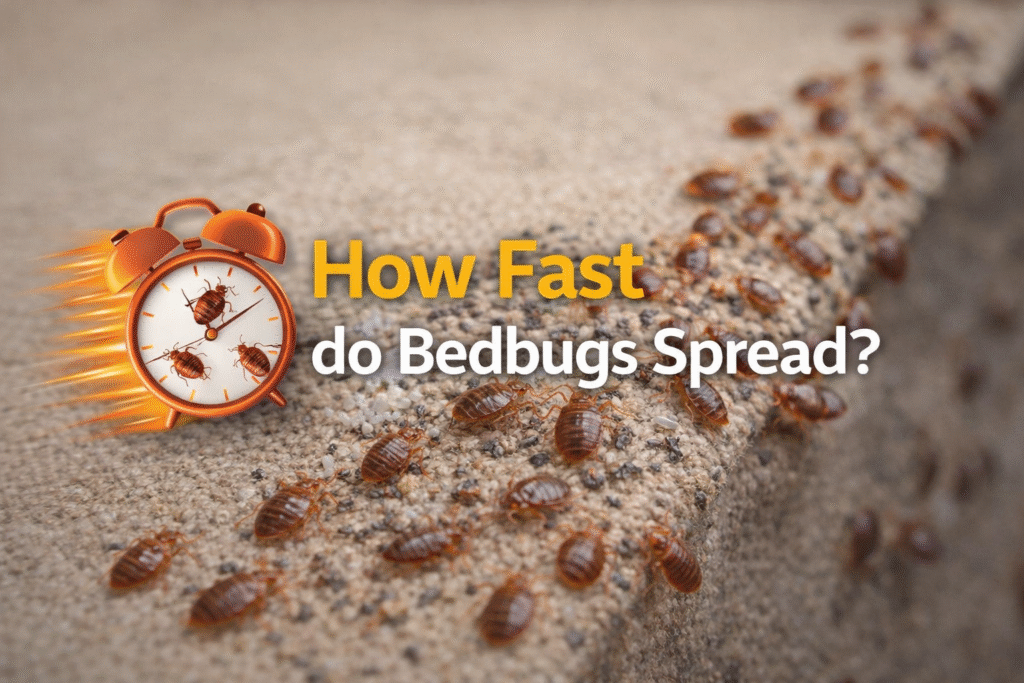
You noticed a few bites on your arm. Then you spotted a tiny reddish-brown bug crawling along the edge of your mattress. Now you’re wondering how bad this can get, and how quickly?
The short answer is: faster than most people expect. Bed bugs are not the slow, lazy pests they might seem. Under the right conditions, a handful of bed bugs can turn into a full-blown infestation in a matter of weeks. Understanding how they spread and what accelerates that spread is the first step toward getting ahead of the problem before it takes over your entire home.
Here’s everything you need to know.
How Fast Do Bed Bugs Actually Multiply?
To understand how quickly bed bugs spread, you have to start with their reproduction rate, and it’s alarming.
A single female bed bug lays between 1 and 5 eggs per day, and up to 500 eggs over her lifetime. Those eggs hatch in about 6 to 10 days. The newly hatched nymphs (young bed bugs) go through five growth stages before becoming adults, and they can reach full maturity in as little as 5 weeks under warm conditions.
Here’s what that looks like in practice: if just a couple of bed bugs hitchhike into your home on a piece of luggage or a secondhand furniture purchase, you could be looking at dozens of bugs within a month and hundreds within two to three months. Left untreated for six months, a small introduction can turn into thousands of bugs spread across multiple rooms.
Temperature plays a major role. Bed bugs thrive between 70°F and 80°F, which is essentially the average indoor temperature in a Minnesota home during winter, when the heat is running. That means there is no “off-season” for bed bugs indoors.
How Do Bed Bugs Spread From Room to Room?
Bed bugs do not fly, and they cannot jump. They move by crawling, which might make you think they spread slowly. But they are surprisingly fast crawlers covering about 4 feet per minute, and they are hitchhikers by nature, latching onto anything that moves.
Here is how they move through a home:
Through walls and electrical outlets. Bed bugs can crawl through wall voids, along pipes, and through electrical outlets to move between rooms — and even between apartments in a multi-unit building. This is why apartment and condo infestations are so difficult to contain.
On clothing and personal items. If someone sits on an infested couch or bed, bugs or eggs can cling to their clothing and be carried to another room, another bed, or even another home entirely.
On furniture and boxes. Moving an infested mattress, couch, or box of belongings from one room to another is one of the fastest ways to spread bed bugs throughout a home.
Along baseboards and flooring. Bed bugs travel along the edges of floors and walls, making it easy for them to move from bedroom to living room to hallway undetected.
This is why acting fast matters so much. Every day of delay gives bed bugs more time to spread deeper into your home and become exponentially harder to eliminate.
What Makes Bed Bugs Spread Faster?
Not all infestations grow at the same rate. Several factors can significantly speed up how quickly bed bugs spread through your home.
Clutter. Bed bugs love to hide. The more clutter you have, stacked boxes, piles of clothing, books, and storage items, the more hiding spots they have and the harder they are to detect and treat.
Multiple sleeping areas. If multiple people sleep in different rooms, bed bugs follow the warmth and carbon dioxide that humans emit during sleep. More occupied sleeping areas mean more potential nesting sites.
Frequent movement of infested items. Carrying infested bedding, clothing, or furniture from room to room, especially before you know you have a problem, is one of the fastest ways to spread the infestation throughout the home.
Delayed treatment. This is the biggest factor of all. Every week without treatment allows another generation of bed bugs to hatch and mature. What starts as a manageable problem in one room becomes a whole-home infestation that requires significantly more time, effort, and cost to eliminate.
Traveling while infested. Bed bugs in your luggage can spread to hotel rooms, and bugs from hotel rooms can come home with you. They can also spread to vehicles, spreading the infestation wherever you park or travel regularly.
How Far Can Bed Bugs Spread Outside Your Home?
Bed bugs do not stay put. Once they are in your home, they can spread outward just as easily as they spread inward.
Visiting a friend or family member’s home while unknowingly carrying bugs on your clothing or bags can start an infestation in their home. Taking infested furniture to a secondhand store, leaving it on the curb, or donating it can expose strangers to bed bugs. In apartment buildings, a single infested unit can spread to neighboring units, above and below, through shared wall voids and plumbing chases, sometimes within weeks.
This is why bed bug infestations in multi-family buildings in St. Paul are treated as a building-wide issue, not just a single unit problem. If you live in an apartment and suspect bed bugs, notifying your property manager immediately is critical not just for your sake, but for your neighbors’.
How to Stop Bed Bugs From Spreading
If you suspect or have confirmed a bed bug problem, the following steps can help slow the spread while you arrange professional treatment:
- Do not move furniture or bedding to other rooms. This is the most common mistake — moving items around spreads bugs further.
- Encase your mattress and box spring in a bed bug-proof cover to trap bugs inside and prevent new ones from nesting.
- Wash and dry all bedding and clothing on the highest heat setting. Bed bugs die at temperatures above 120°F.
- Reduce clutter to limit hiding spots and make treatment more effective.
- Avoid sleeping in a different room. It sounds logical to move to the couch, but this only encourages bed bugs to follow you and spread to new areas.
- Call a professional immediately. DIY sprays and store-bought treatments rarely eliminate a bed bug infestation. They may kill some surface bugs but leave eggs and hidden colonies untouched, giving the infestation time to rebound.
At Pest Control St. Paul, our bed bug exterminator team in St. Paul, MN, uses heat treatments and EPA-approved methods designed to eliminate bed bugs at every life stage, eggs, nymphs, and adults in a single visit. We offer same-day inspections and flexible scheduling so you can get ahead of the problem before it gets worse.
Signs Your Bed Bug Problem Is Already Spreading
If you’re unsure whether your infestation has moved beyond the original room, watch for these warning signs in other areas of your home:
- Bite marks appearing on people who sleep in different rooms
- Small rust-colored stains on furniture, baseboards, or walls in new areas
- A sweet, musty odor in rooms where there was none before
- Live bugs or shed skins found away from the bedroom on sofas, in closets, or along baseboards in hallways
Any of these signs in multiple rooms means the infestation has already spread, and professional treatment is urgently needed.
When to Call a Professional Bed Bug Exterminator
The truth is that bed bugs are one of the hardest pests to eliminate without professional help. They hide in places most people would never think to look inside electrical outlets, behind picture frames, inside the seams of curtains, and inside furniture joints. They are resistant to many over-the-counter insecticides, and their eggs are nearly impossible to kill without heat or specialized treatment.
If you are finding bed bugs in more than one room, if home treatments have not worked, or if you simply want to deal with this correctly the first time, professional treatment is the answer.
Our team at Pest Control St. Paul has helped hundreds of homeowners across St. Paul and the Twin Cities metro area eliminate bed bug infestations quickly and completely. We stand behind our work with a satisfaction guarantee, and our treatments are safe for children and pets.
Do not wait for the infestation to double or triple in size. Contact us today for a free consultation, or call us at 651-505-8151.
Frequently Asked Questions
Q: How fast do bed bugs spread from room to room?
Bed bugs can begin spreading to adjacent rooms within days of establishing themselves in one location. They crawl along baseboards, through wall voids, and along electrical wiring. In a warm home with multiple sleeping areas, bed bugs can spread to every room within 4 to 8 weeks if left untreated. The speed depends on the number of bugs, the temperature, and how much clutter provides additional hiding spots.
Q: Can bed bugs spread through walls to neighbors?
Yes. In apartment buildings, condos, and townhomes, bed bugs regularly spread between units through shared wall voids, electrical outlets, and plumbing chases. If you live in a multi-unit building and discover bed bugs, notify your property manager right away. A building-wide inspection is often necessary to prevent the infestation from cycling back into treated units from untreated neighboring ones.
Q: How long does it take for a bed bug infestation to become serious?
A small introduction of bed bugs, even just a single mated female, can become a noticeable infestation in 6 to 8 weeks. Within 3 to 4 months, hundreds of bugs can be present across multiple areas of a home. This is why early detection and immediate action make such a dramatic difference in how difficult and expensive treatment becomes.
Q: Can bed bugs spread to my car?
Yes. If you sit in your car after being in an infested area, or transport infested luggage or clothing in your vehicle, bed bugs can establish themselves in your car’s upholstery, carpet, and seat seams. While a car is not an ideal long-term environment for bed bugs since they prefer the proximity to sleeping humans, they can survive there and be transported to new locations. If you suspect your car is infested, it should be treated at the same time as your home.
Q: Do bed bugs spread faster in summer or winter?
Bed bugs spread faster in warmer temperatures, as heat accelerates their reproductive cycle and increases their activity level. However, indoors in Minnesota, temperatures stay consistently warm year-round thanks to central heating — which means bed bug infestations can grow just as quickly in the middle of a St. Paul winter as they can in July. There is truly no slow season for an indoor bed bug infestation.
Q: Will bed bugs go away on their own if I stop sleeping in the infested room?
No. Bed bugs will not go away on their own, and moving to another room actually makes the problem worse. Bed bugs follow the carbon dioxide and warmth of sleeping humans. When you relocate, the bugs follow you, spreading the infestation to a new area. The only way to eliminate a bed bug infestation is through direct treatment of all affected areas, ideally by a professional exterminator using heat treatment or targeted pesticide application.
Q: How do I know if bed bugs have spread to my couch or living room furniture?
Inspect the seams, folds, and undersides of your couch and chairs; these are the spots bed bugs prefer. Look for small dark spots (fecal stains), shed skins, tiny white eggs, or live bugs. A flashlight and a credit card to run along seams can help expose hiding bugs. If you spot any of these signs outside the bedroom, your infestation has already spread, and you should contact a professional bed bug exterminator in St. Paul without delay.